

Enterprise and IT Governance Services that Drive STAR Performance
Traditional corporate governance acts as a brake pedal. We design it to be an accelerator. Move away from sluggish committees and political gridlock and deploy a continuous, closed-loop command engine built to sustain operational velocity.
Clashes, Red Tape, and Poor Communication Destroy Strategic Execution
Most organizations treat governance as a passive administrative chore. It becomes a disjointed series of slow review boards, manual approvals, and retroactive auditing cycles. This legacy approach creates critical organizational pathologies across four distinct operational perspectives:
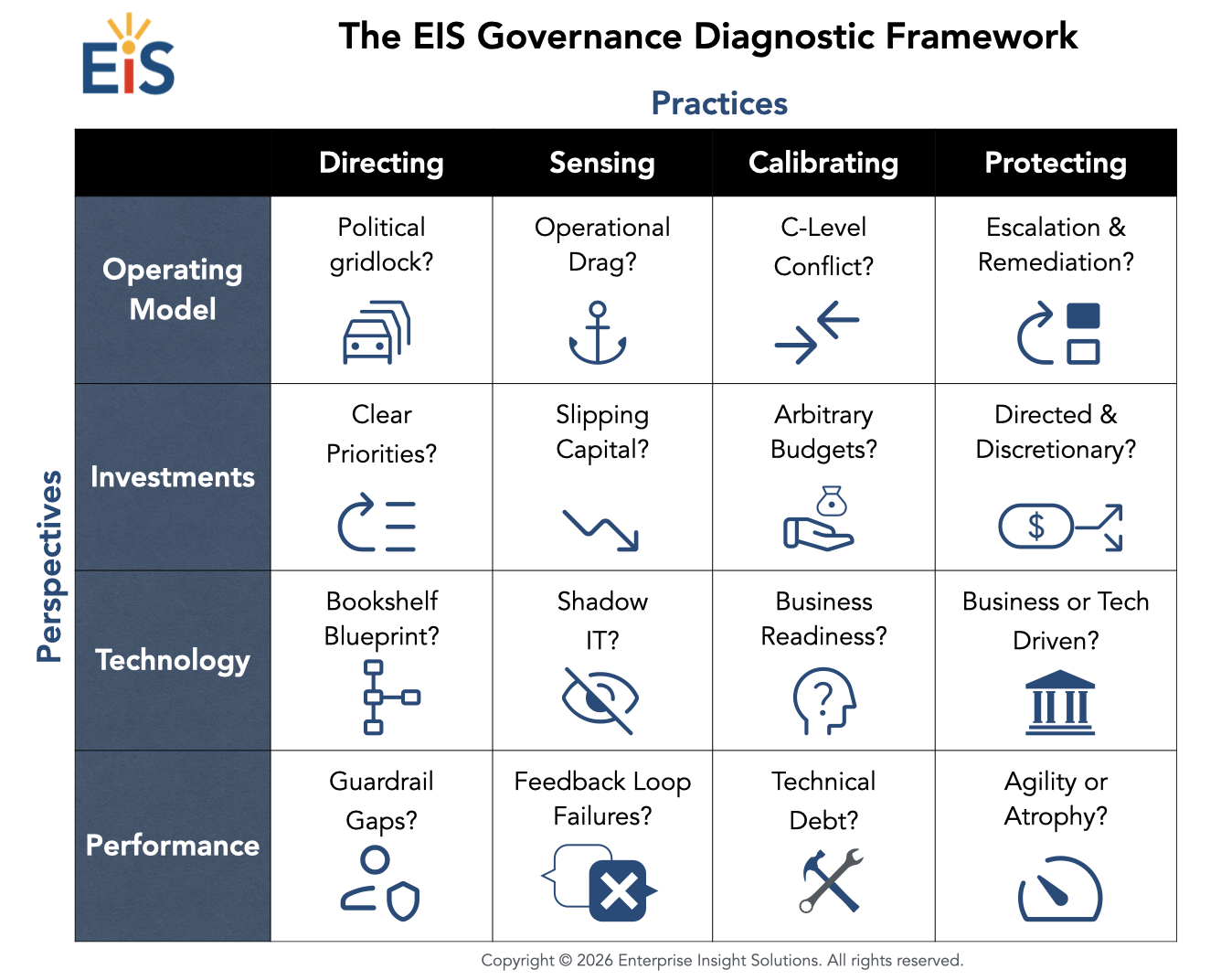
Operating Model Gridlock. Executive leadership gets trapped in continuous political friction, stalling strategic transformation and turning active execution into operational drag.
Slipping Capital. Investment portfolios suffer from severe information latency. Capital is allocated based on arbitrary budgets rather than real-time performance indicators.
The Bookshelf Blueprint. Complex technical architectures and data definitions are authored by committees, stored in unread directories, and completely detached from active systems.
Feedback Loop Failures. Organizations accumulate massive technical, operational, and structural debt, creating a slow systemic atrophy that paralyzes long-term organizational agility.
Culture Clashes. Misaligned organizations compete for resources which destroys cultural cohesion and channels resources where they don’t support strategy.
Governance Is Your North STAR
The Mirriam-Webster dictionary defines governance as the “act or process of governing or overseeing the control and direction of something.” Governing happens at many levels within an organization: within the Board, committees, directors’ offices, and in the business units. Getting governance right is essential to ensure your organization is delivering value and meeting expectations.
Governance Gaps and Gridlock Guide Failure
Most organizations treat governance as a passive administrative chore. It becomes a disjointed series of slow review boards, manual approvals, and retroactive auditing cycles. This legacy approach creates critical organizational pathologies across four distinct operational perspectives:
Operating Model Gridlock: Executive leadership gets trapped in continuous political friction, stalling strategic transformation and turning active execution into operational drag.
Slipping Capital: Investment portfolios suffer from severe information latency . Capital is allocated based on arbitrary budgets rather than real-time performance indicators.
The Bookshelf Blueprint: Complex technical architectures and data definitions are authored by committees, stored in unread directories, and completely detached from active systems.
Feedback Loop Failures: Organizations accumulate massive technical, operational, and structural debt, creating a slow systemic atrophy that paralyzes long-term organizational agility.
When decisions are slow, missing, or misaligned, the organization experiences significant drag, or even worse: it fractures.

The STAR Principles of Great Governance
The STAR Engine functions within the EIS Management Framework, stabilizing the critical intersection where Governance (Performance Accountability), Management (Operational Agility), and Delivery (Value Generation) converge. By anchoring your strategy at this nexus, we turn organizational compliance into real-world value generation.
STAR stands for the coregovernance principles that drive great decisionmaking. These principles are accompanied by an architectural framework engineered to operationalize your governance system down to the practical layer, guaranteeing that corporate choices remain systematic, data-driven, and highly effective.
The Four Pillars of STAR
S - Structured
This principle focuses on establishing procedural integrity across the enterprise. It standardizes how operational exceptions are evaluated by utilizing documented delegated authorities, committee architecture, predictable intake blueprints, standardized templates, and explicit criteria to ensure both fairness and decision speed.
T - Transparent
Operating alongside structure, transparency ensures that corporate decisions are never arbitrary, political, or "black-box" events. Under this pillar, every single operational or strategic decision must manufacture a tangible, securely logged Governance Product that explicitly dictates the boundaries of business freedom or restriction.
A - Adaptive
This principle ensures that your governance architecture functions as an operational engine rather than a bureaucratic bottleneck. It mandates a dynamic control scale where low-risk product or operational initiatives bypass heavy committee reviews entirely to maintain organizational velocity, while high-risk threshold breaches automatically halt execution and force immediate escalations or independent reviews.
R - Rapid
This pillar governs the data metabolism and sensory telemetry of the enterprise. It mandates that decision-making latency must be minimized, forcing information, risk signals, and telemetry to flow at the native clock-speed of your business dynamics so leaders never exercise judgment based on sluggish or decaying data.
The STAR Governance Engine
We design and deploy a dynamic, continuous operating loop directly into your business. The STAR Engine runs on a 4-part Direct-Sense-Calibrate-Protect architecture to guide your high-velocity performance:
DIRECTING across Structured Boundaries
We eliminate the pathology of passive documentation. We define clean, unambiguous decision rights, operational parameters, and delegated authorities. We ensure that core policies (using our Universal Policymaking Framework), architectures, and templates are systematically available, current, and in use across your operating fabric.
SENSING through Adaptive Telemetry
We eliminate information latency. We embed active tracking loops across your enterprise to monitor performance fluctuations, technical drift, and emerging systemic vulnerabilities in near-real-time—filtering out background operational noise to deliver pure strategic signals to leadership.
CALIBRATING for Low-Latency Decision-Making
We replace slow, political committee reviews with continuous, low-latency decision-making essential for modern business. By utilizing standardized intake blueprints and automated trigger criteria, the STAR engine dynamically adjusts operational parameters and executes administrative choices at the exact speed of your market.
PROTECTING across the Enterprise
Speed requires safety. We construct automated corporate guardrails and sandboxes that satisfy elite global risk criteria (COBIT, ISO 37000, NIST SP 800-207, COSO ERM), isolating localized failures instantly before they can cascade across the enterprise.
Aligned Execution at Every Level
The STAR Engine configures your command and decision structure across four precise operational scales, linking executive leadership directly to your automated asset telemetry:
Enterprise Scale. Corporate-wide governance, sponsored by the Board and executive office, focusing on enterprise performance, market capitalization, capital allocation, and macro-policy creation.
Segment Scale. Domain-level oversight managing specific division towers, core operational business units, and cross-functional program portfolios.
Function Scale. Shared corporate practices responsible for authoring the structural templates, data frameworks, privacy guidelines, and baseline compliance rules used by your operational teams daily.
Asset Scale. Component-level guardrails governing localized software products, engineering pipelines, technical standards, and individual AI agents to ensure runtime compliance at machine-speed.
Governance Sub-System Support
Governance is a system of controls, we offer high-velocity solutions to manage the core infrastructure of your enterprise bridge:
Enterprise Architecture (EA). EA is a practice and a resource. The practice collaborates with business to capture business performance objectives, business process information, and the data managed across the enterprise. Technologists are engaged to capture technical standards, and the systems that support the business. The resource is the integrated repository that connects this information to characterize the current architecture as well as interim and target architectures. Organizations assess technology proposals against the EA to determine fit and minimize duplicative investments.
Investment Governance. Investment governance is the process of collecting, selecting, controlling, and evaluating investments. The goal is to ensure that every dollar invested delivers real value.
Policymaking & Compliance. Policies establish operational guardrails to ensure safe, ethical, fair, responsible, and compliant operations. They ensure employees, customers, regulators, and auditors know that ways of working are bounded and controlled.
Execution Insight. Decision makers need information to do their job well. Execution insight is the result achieved by mapping out oversight and decision information needs, timing, and formats that are delivered through low-latency information pipelines, automation, and dashboards.
We help you pinpoint governance gaps and solutions using our proprietary EIS Governance Diagnostic Framework that identifies governance gridlock and targets improvement.
You Have Questions. We Have Answers.
-
No. In fact, it hardens them. Traditional governance relies on manual human checklists, which are inherently prone to friction, error, and exhaustion. The STAR engine achieves velocity precisely because it builds automated compliance parameters directly into your technical and operational pipelines. By aligning our Protecting layer directly with top-tier global standards (COBIT, ISO, COSO, NIST), we ensure your compliance is continuous, objective, and auditable.
-
They serve as our initial discovery sprint. Over a two-week window, the EIS Governance Diagnostic uncovers active process friction and informational latency, while the A3M Framework maps your socio-technical skill alignments. Together, they provide the exact telemetry data needed to calibrate the STAR Engine's parameters to your specific organizational model.
-
Not at all. STAR is entirely framework-agnostic. We view COBIT, ISO, or NIST as your governance criteria, while STAR is the operating engine that actually executes them. We don't change your compliance standards; we dramatically accelerate your ability to enforce and monitor them across all organizational scales.
-
It means eliminating the requirement to "wait until the next monthly committee meeting" to resolve an operational exception. By setting pre-defined trigger criteria and automated sandboxes, low-risk operational adjustments happen instantly at the micro and nano scales, while high-risk structural anomalies are routed instantly to the right decision-makers with a fully prepared data packet—clearing the fog before it compromises momentum.