

Governance Support Services Powered by the Universal Policymaking Framework
Policies are born out of a noble purpose: they exist to align organizational practices, mitigate systemic risk, and make operational expectations crystal clear. When done right, they serve as the cultural and legal guardrails that allow an enterprise to scale safely and predictably.
But too often, reality gets in the way. Without a strict structural architecture, policies grow organically and chaotically. What starts as a well-intentioned rulebook quickly propagates into a confusing, misaligned management nightmare—a fragmented labyrinth of outdated PDFs, clashing directives, and forgotten memos buried deep in corporate directories.
The EIS Universal Policymaking Framework was engineered to end this administrative drag. It is an essential guide to building out high-performance policies by directly conquering the critical friction points that cripple modern operations.
Organize Your Policy Framework and Policy Integration
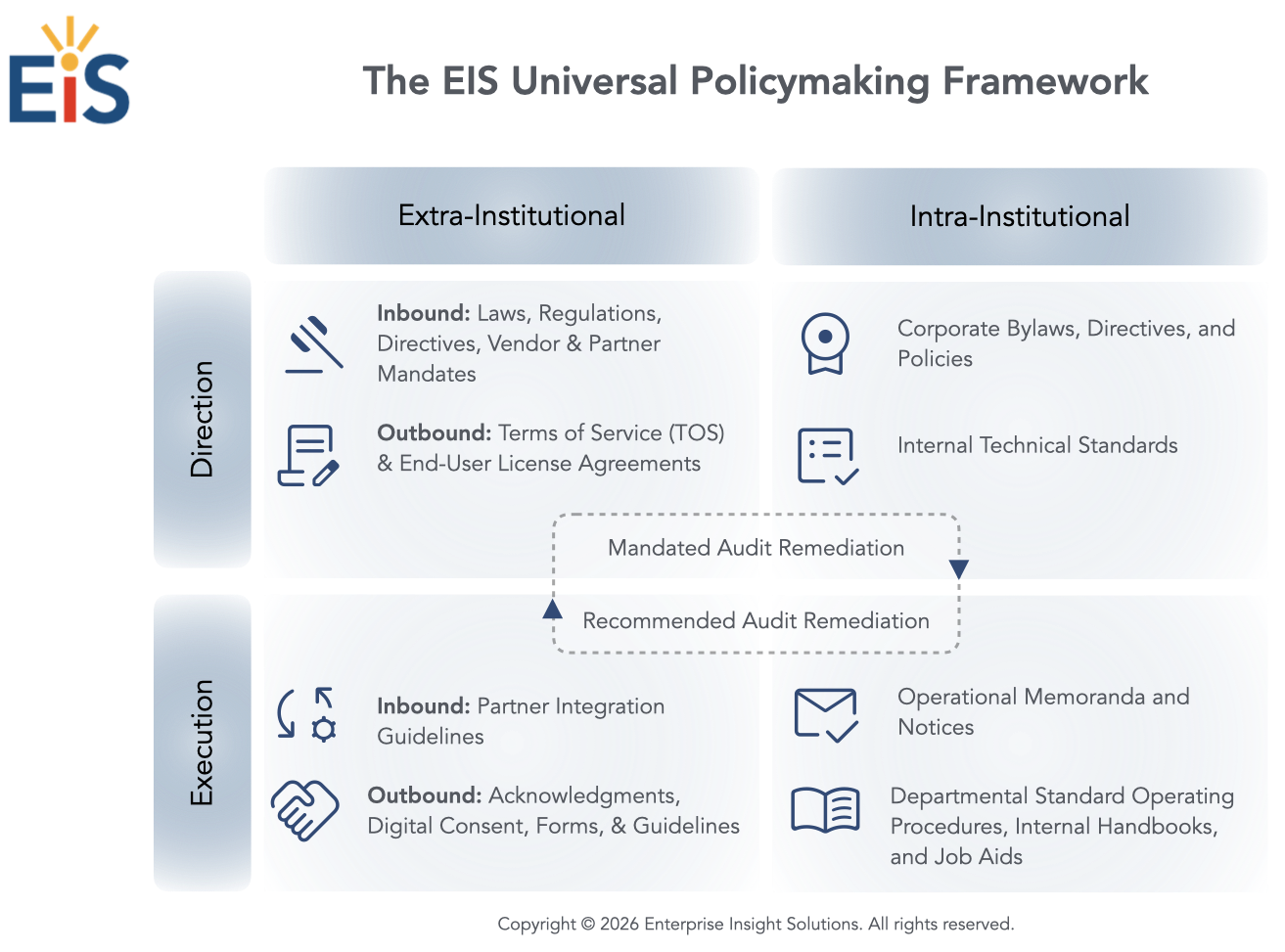
In today's complex regulatory and commercial landscape, institutional governance shouldn’t be a maze of disconnected documents. True operational resilience requires a clear line of sight between high-level mandates and daily front-line actions.
The EIS Universal Policymaking Framework is a streamlined, 2×2 classification matrix that categorizes your organizational documentation by Scope (Extra-Institutional vs. Intra-Institutional) and Intent (Directing vs. Elaborating). It transforms static paperwork into a dynamic blueprint for compliant, safe, and high-performance execution.
The Core Dimensions of the Policy Framework
1. Navigating External Realities: Extra-Institutional Governance
Organizations do not operate in a vacuum. To scale securely, an enterprise must balance the constraints forced upon it with the rules it projects outward to the world.
Inbound Mandates (Direction): Seamlessly ingest and respect sovereign public laws, statutory regulations, and non-negotiable vendor or partner mandates. The framework positions these external pressures as baseline boundaries that dictate internal behavior.
Outbound Agreements (Direction): Establish the legal guardrails that protect your enterprise when interacting with users through robust terms of service (TOS) and end-user license agreements (EULAs).
External Handshakes (Execution): Translate external relationships into smooth, technical execution using partner service levels, third-party integration guides, and clear digital consent mechanisms.
2. Setting the Internal Baseline: Intra-Institutional Directives
A compliant and effective operating environment relies on a transparent internal chain of command. The Intra-Institutional domain establishes internal authority, assigning ownership and setting clear corporate boundaries.
Corporate Governance: Anchor the organization’s supreme authority with corporate bylaws, articles, and corporate directives.
Internal Standards: Align cross-functional teams with internally focused policies and technical standards, ensuring a uniform baseline for security, quality, and workplace ethics.
3. Driving Consistent Action: The Power of Elaborating Documents
High-level directives establish what the rules are, but elaborating documents provide the tactical clarity people need to manage and deliver consistently and safely every day.
Operational Clarity: Bridge the gap between high-level strategy and daily front-line execution using granular departmental standard operating procedures (SOPs), internal handbooks, and practical job aids.
Agile Communications: Keep teams responsive, safe, and aligned in real-time through authoritative operational memoranda and notices that scale alongside shifting corporate needs.
Benefits of the Universal Policymaking Framework
Beyond simply organizing files, this framework acts as a diagnostic and corrective tool for the most common structural traps in enterprise management:
The "Frankenstein" Policy Library (Policy Bloat): Over time, organizations accidentally create overlapping documents that say slightly different things. By enforcing a strict binary split between Directing and Elaborating documents, the framework drives out redundancy and prevents conflicting rules from coexisting.
The Compliance Cascade Cracks: Many corporate systems suffer from high-level policies that lack operational teeth, or hyper-specific job aids that are completely unanchored to legal authority. This framework establishes an unbreakable, vertical hierarchy ensuring every front-line SOP is legally tethered to a corporate directive.
The External-Internal Disconnect: Organizations frequently struggle to balance inbound compliance pressures (like public laws and strict vendor mandates) with outbound user agreements (like TOS and EULAs). This matrix cleanly segments the Extra-Institutional boundary, giving risk management teams a unified dashboard for external risks.
The Audit Panic Loop: For most companies, audits are an unpredictable fire drill. By positioning a centralized audit remediation loop at the dead center of the framework, compliance changes cease to be an emergency. Instead, audit findings become a routine engine that automatically refines and improves operational practices that deliver value.
Shadow Compliance & Maverick Workflows: When policies are unreadable or hard to locate, departments inevitably invent their own shadow rules to get work done. This framework provides an intuitive taxonomy that ensures employees can find the exact operational clarity they need to execute their jobs safely and consistently.