

Enterprise Architecture Services: Where Strategy & Governance Meets Execution
Bridge the Gap Between Vision and Execution
The business and technology landscape is changing faster than ever. Businesses must ensure that disconnected systems and misaligned strategies stall growth. Enterprise Insight Solutions (EIS) designs agile, secure, and data-driven enterprise architectures that transform organizational complexity into streamlined business value. We don't just plan for the future; we build the blueprint to get you there.
Why Modern Enterprises Stall
Without a structured architectural runway, scaling becomes an expensive exercise in firefighting. We typically see organizations struggling with four core challenges:
Strategy-to-Execution Disconnect: Business goals say one thing, but IT systems and data assets are pulling in another direction, leading to wasted capital and missed market opportunities.
Growing Technical Debt: Legacy systems, fragmented applications, and undocumented patches create an unstable foundation that resists innovation and absorbs precious resources.
Data Chaos & Silos: Data is trapped in disconnected silos without clear ownership, undermining analytics, compliance, and confident decision-making.
Compliance & Audit Vulnerabilities: Navigating complex federal mandates, defense standards, or strict industry regulations without rigorous oversight risks project delays and costly penalties.
Enterprise Architecture Support, Where You Need It
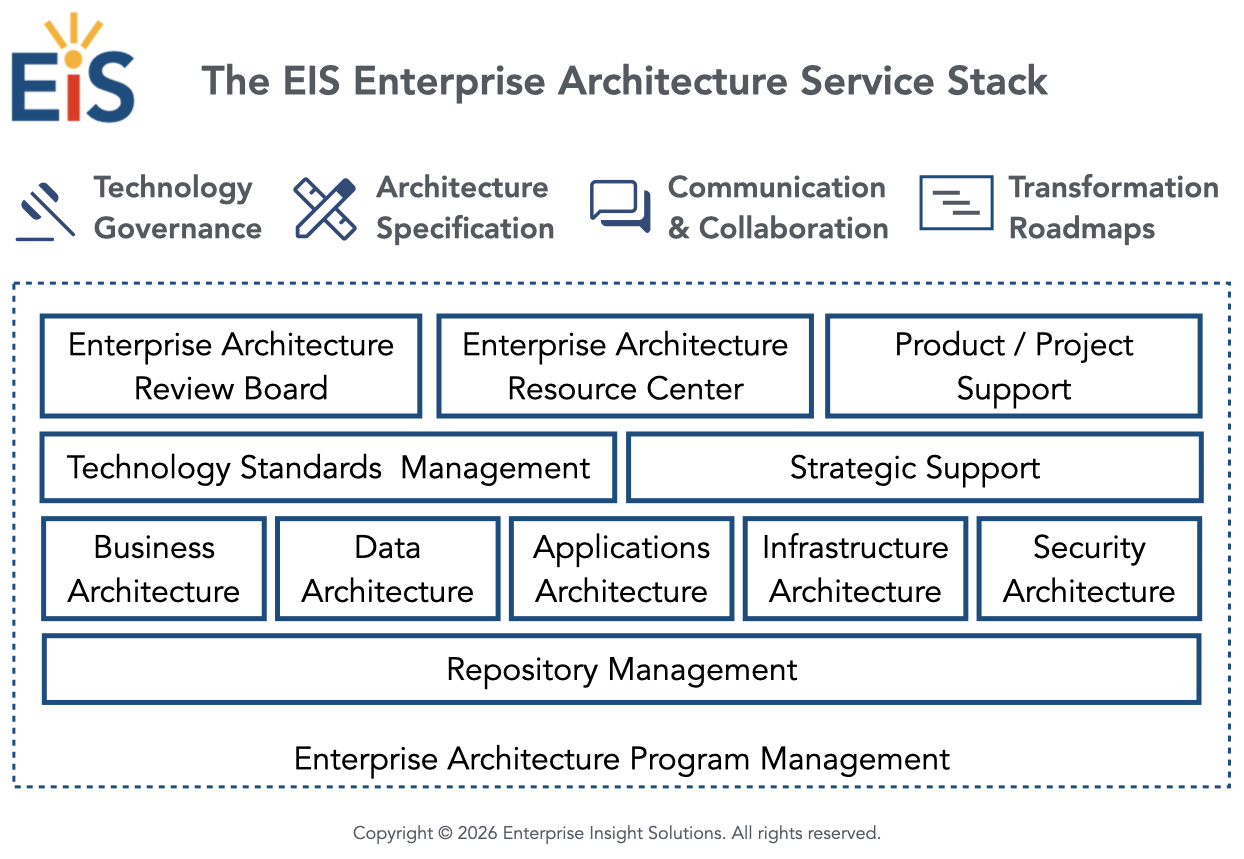
The EIS Solution: Principle-Driven Purposeful Design
We don't believe in academic, shelf-ware architecture. We deliver practical, actionable blueprints tailored to your specific operating model, driven by an uncompromising set of execution standards.
Our Core Enterprise Architecture Service Principles
Before looking at the technical stack, we anchor our approach in four core execution principles that ensure your architecture delivers real, measurable utility:
Business-Led & Value-Driven (Why It Matters): Architecture is tightly coupled with your business strategy, investment governance, and organizational change. It’s not just an IT exercise. Every capability map, roadmap, and target state we design is thoughtfully tethered to a strategic business outcome or mission objective. If an architectural decision doesn't drive value, reduce costs, or mitigate risk, it doesn't belong in your blueprint.
Radical, End-to-End Integration (Eliminating Silos): True EA cannot exist in a vacuum. We ensure your architecture is fully integrated internally to connect business capabilities, data assets, applications, and technology infrastructure in alignment with capital planning, PMO, governance, and your delivery methodologies.
Actionable Precision over Academic Complexity (Generating Insights): A thousand-page framework that nobody understands is a failure of architecture. We favor accuracy, clarity, and utility over academic bloat, translating complex systems into high-fidelity, insight-generating blueprints accompanied by clear business-aligned roadmaps. Executives get data for rapid decisions; technical teams get precise direction to build.
Compliant by Design (De-Risking the Portfolio): In highly regulated spaces, compliance cannot be a reactive afterthought. We bake security, interoperability, and compliance directly into the fabric of your architecture, establishing lean, effective governance that protects the enterprise without choking innovation.
Benefits of Principled, Purposeful Enterprise Architecture
By combining these principles with proven industry frameworks, we deliver targeted expertise across four critical pillars:
1. Business & Technology Alignment (TOGAF & BizBOK)
We map your business capabilities directly to your technology footprint. By aligning your business architecture with your application and technology layers, we ensure every IT investment directly moves the needle on your corporate strategy.
2. Federal & Defense Compliance (FEAF & DoDAF)
For organizations navigating government ecosystems, we bring deep expertise in Federal Enterprise Architecture Framework (FEAF) and Department of Defense Architecture Framework (DoDAF). We build compliant, audit-ready architectures that meet rigorous federal requirements without sacrificing agility.
3. Data Governance & Modeling (DMBOK & UML)
Leveraging the Data Management Body of Knowledge (DMBOK) and formal Unified Markup Language (UML) modeling, we treat data as a strategic enterprise asset. We design robust data architectures that ensure data quality, lineage, and security across the entire enterprise lifecycle.
4. EA Program Management & Governance (EARBs & Roadmaps)
Business is constantly changing. That means your architecture is a dynamic, responsive expression of your strategy. Architecture is a journey, not a project. Our management approach is structured, collaborative, alert, and committed to delivering value. This approach ensures Enterprise Architecture Review Boards (EARBs), facilitate iterative capability roadmaps, and ensure that every business-driven technology standard, product, and system advances your strategy.
You Have Questions. We Have Answers.
-
Our principle-driven approach is framework agnostic. We adopt and employ what is right for you. Depending on your industry and objectives, we blend TOGAF for overarching structure, BizBOK for business architecture, and DMBOK for data governance. For government and defense contractors, we support FEAF and DoDAF.
-
While both disciplines use structured, systems-thinking methodologies, they operate at entirely different scopes and lifecycle stages:
Enterprise Architecture (EA) focuses on the macro-level ecosystem. It defines the what and the why across the entire organization. EA creates a line-of-sight across business, data, systems, and infrastructure with long-term corporate strategy, driving the rules, standards, and roadmaps that dictate which initiatives get greenlit.
Systems Engineering (SE) focuses on the micro-level execution. It looks at the how. Once EA determines that a specific system is needed, SE takes over to manage that distinct system’s requirements, technical design, integration, and lifecycle to ensure it performs flawlessly.
The Analogy: Enterprise Architecture is the city’s master zoning plan and infrastructure layout; Systems Engineering designs and builds the individual skyscrapers to code within that plan.
In highly structured environments like DoDAF or FEAF, EA maps out the overarching operational and mission capabilities needed across the enterprise, while SE delivers the technical systems required to realize those specific capabilities.
-
Enterprise architecture programs are primarily operated within the IT organization, but EA is all about the business. Technology is woven into every business process. It is foundational to how work gets done. Successful EA programs are stewards of how technology enables business strategy. The business is the owner of EA information. The EA staff ensure it is used to deliver results through adaptive and compliant technology alignment.