

From Red Tape to Red Carpet: Transforming Compliance into a Strategic Advantage
The modern business landscape is shifting under our feet. The legal and regulatory environment is in a state of constant, often unpredictable change. For many organizations, compliance is a source of perpetual friction—a series of unplanned demands that clash violently with existing business strategies and priorities. It’s often viewed as a cost center, a necessary evil, or a burden of "red tape" that slows down innovation and eats into profits.
However, this reactive mindset is a liability. The costs of non-compliance are far too high to ignore, capable of wiping out years of planned business gains through reputational damage and massive fines. To thrive, organizations must transform compliance from a cost to a contribution.
1. Integrate Compliance into Enterprise Risk Management (ERM)
Compliance risks do not exist in a vacuum; they are inextricably linked to operational, financial, and strategic risks. Yet, in many companies, the compliance function is siloed, separated from the broader ERM discussion.
To drive value, organizations must ensure their ERM framework is fully aware of compliance risks. When compliance is integrated into ERM, regulatory changes aren't seen as isolated annoyances but as key variables affecting the company's overall risk profile (Committee of Sponsoring Organizations of the Treadway Commission [COSO], 2020). This holistic view allows leadership to make informed decisions that balance risk and opportunity, rather than just reacting to the latest mandate.
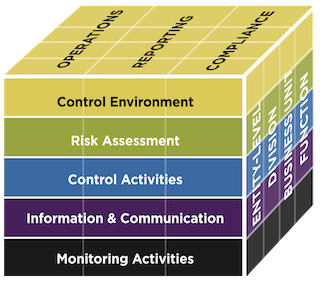
COSO Internal Control Framework
Source: https://www.coso.org
2. Quantify the Benefits and the Costs
Leaders often focus on the easily quantifiable cost of compliance software or headcount. To shift toward a value-oriented model, organizations must quantify the "unquantifiable." Robust models can be used to estimate, prioritize, and mitigate compliance risks and their associated insurance, operational, administrative, and reputational costs.
The Cost of Non-Compliance
Costs go beyond initial fines. They include operational disruption, remediation efforts, and long-term reputational damage. A stark example of this occurred with TD Bank. In October 2024, TD Bank N.A. pleaded guilty to conspiracy to commit money laundering. The $1.8 billion in penalties were a direct result of "long-term, pervasive, and systemic" failures to monitor trillions of dollars in transactions (U.S. Department of Justice, 2024). Beyond the fine, the Office of the Comptroller of the Currency (OCC) imposed an asset cap, effectively halting the bank's ability to grow its U.S. retail business—a strategic blow far outweighing the fine itself (Office of the Comptroller of the Currency, 2024).
The Value of Compliance
Conversely, a robust compliance program builds trust. Ethical behavior and transparency can be leveraged as a market differentiator. Compliance also drives operational excellence by forcing the standardization and automation of complex processes.
A primary example is Microsoft’s response to the General Data Protection Regulation (GDPR). While many firms viewed GDPR as a restrictive hurdle, Microsoft embraced the regulation as an opportunity to lead on privacy. In 2018, Microsoft’s President and Chief Legal Officer, Brad Smith, announced that the company would extend the core rights of the GDPR to all its customers globally, not just those in the EU (Microsoft, 2018). By proactively aligning its global infrastructure with these high standards, Microsoft positioned itself as a "trusted cloud" provider. This move turned a regulatory mandate into a significant business contribution, attracting enterprise clients who prioritized data security and ethical handling (Microsoft, 2018).
3. Plan for Compliance
Treating regulatory change as an "unforeseen" event is a failure of planning. Because the regulatory environment is in constant flux, organizations must budget for mandates just as they do for R&D or marketing. Allocating resources—both financial and human—anticipates that rules will change. Establishing communication, engagement, and integrated execution practices for compliance is essential for fielding mandates as they arise. This "regulatory contingency" prevents compliance demands from hijacking ongoing business operations. It turns a disruptive emergency into a managed process, ensuring strategic initiatives stay on track even when the rules of the game change.
Conclusion
The choice is clear. You can continue to view compliance as a burden, constantly fighting fires and risking catastrophic failures. Or, you can change your perspective. By integrating compliance into your strategic risk view, quantifying its true value, and proactively planning for change, you can transform it from red tape into a red carpet for sustainable performance.
References
Committee of Sponsoring Organizations of the Treadway Commission. (2020). Compliance risk management: Applying the COSO ERM framework. https://www.coso.org/Shared%20Documents/Compliance-Risk-Management-Applying-the-COSO-ERM-Framework.pdf
Microsoft. (2018, May 21). Microsoft’s commitment to GDPR, privacy and putting customers in control of their own data. Microsoft On the Issues. https://blogs.microsoft.com/on-the-issues/2018/05/21/microsofts-commitment-to-gdpr-privacy-and-putting-customers-in-control-of-their-own-data/
Office of the Comptroller of the Currency. (2024, October 10). OCC assesses $450 million civil money penalty over TD Bank N.A. AML deficiencies and imposes asset cap [Press release]. https://www.occ.gov/news-issuances/news-releases/2024/nr-occ-2024-116.html
U.S. Department of Justice. (2024, October 10). TD Bank pleads guilty to conspiracy to commit money laundering and ordered to pay over $1.8 billion in penalties [Press release]. https://www.justice.gov/archives/opa/pr/td-bank-pleads-guilty-bank-secrecy-act-and-money-laundering-conspiracy-violations-18b